


As AI adoption grows, organizations are facing a new challenge: how to use sensitive data to build better machine learning models without exposing that data to unnecessary risks.
Healthcare providers, financial institutions, and enterprises often hold valuable information that could improve AI systems, but privacy concerns, regulations, and data sharing restrictions can prevent them from using it effectively.
Privacy preserving machine learning provides a way to address this challenge by allowing organizations to work with sensitive information while maintaining strict control over how that data is accessed and processed.
Technologies such as fully homomorphic encryption, secure multiparty computation, federated learning, and differential privacy are helping companies develop AI systems that meet modern privacy and security requirements.
In this guide, we explore how privacy preserving machine learning works, how leading approaches compare, and how organizations can apply these technologies to build secure AI systems using sensitive data.
What Is Privacy-Preserving Machine Learning (PPML)?
Privacy-preserving machine learning is the practice of training, tuning, and running inference on machine learning models without exposing the sensitive data used throughout the process.
Instead of relying only on access controls, contracts, or security measures around data storage, PPML uses privacy-enhancing technologies (PETs) to protect data during computation and reduce the risk of unauthorized access or exposure.
- PPML is not a single technology. It is a collection of approaches that includes fully homomorphic encryption (FHE), secure multiparty computation (MPC), federated learning (FL), differential privacy (DP), and confidential computing.
- Confidential Computing / TEEs Protects data and models while they are in use by running computation inside hardware-isolated enclaves. It is currently the practical approach for protecting large-scale LLM inference workloads.
Each method addresses a different privacy challenge: some protect data during collaboration, some protect data while it is being processed, and others reduce the risk of revealing information from the final model.
The objective is to maintain model performance while ensuring that sensitive data remains protected throughout the machine learning lifecycle.
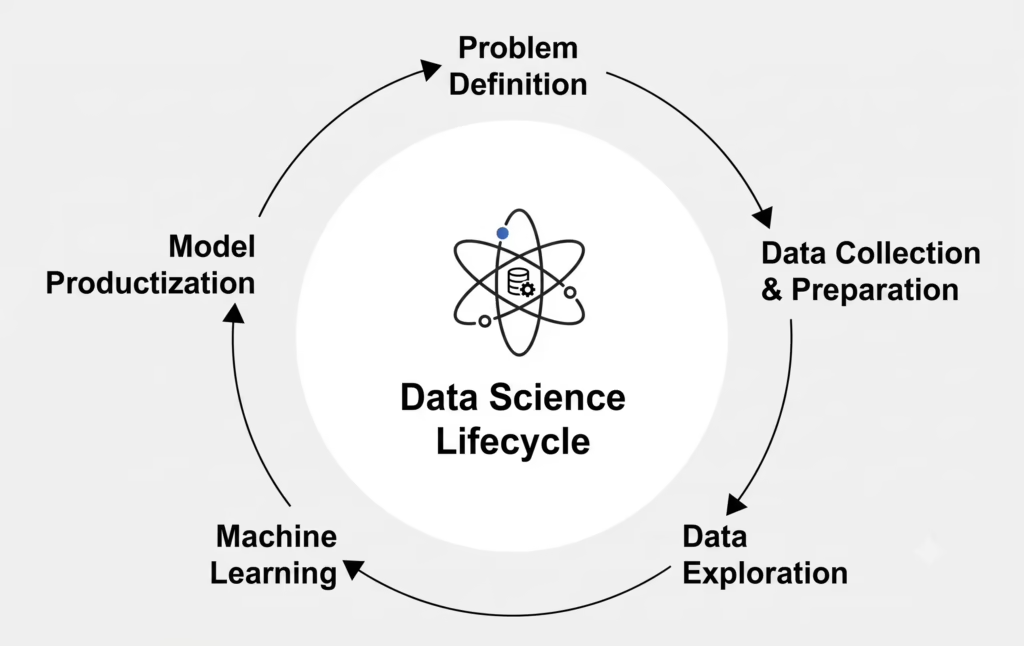
The Data Science Lifecycle
To see where privacy fits into machine learning, it helps to look at the full data science lifecycle. Every model goes through five stages, and data can be exposed at any one of them if it is not protected end to end.
- Problem definition. Data scientists decide what the model needs to solve or predict, and whether that means touching sensitive or regulated data.
- Data collection and preparation. Teams gather data from every relevant source and work out what is confidential and how it is structured.
- Data exploration. Data scientists study where the data lives (centralized or spread across organizations), how records link across datasets, and how sensitive each field is.
- Model training. This is where the actual learning happens: choosing a new model or tuning an existing one, deciding how training is distributed, and setting accuracy targets.
- Model deployment and monitoring. Teams evaluate results in production and watch for drift, misuse, or new privacy risks as the model is used.
Privacy has to be built into every one of these stages, not bolted on at the end. A model that protects data during training but leaks it during inference has not solved the problem. It has just moved it.
What Is the Difference Between FHE, MPC, Federated Learning, and Differential Privacy?
These four techniques get grouped together constantly, but they solve different problems and they are not interchangeable. Here is how they actually compare.
Technique | What it protects | How it works | Tradeoff |
Fully Homomorphic Encryption (FHE) | Data while it is being computed on | Runs computations directly on encrypted data, so results only make sense once decrypted by the key holder | Real compute overhead. Order 10,000x versus plaintext on CPU-only stacks, narrowing to roughly 10x–100x for batched, throughput-oriented workloads with GPU acceleration. Practical today for analytics, encrypted queries and inference on specific model families; not yet practical for interactive computation on very large models. |
Secure Multiparty Computation (MPC) | Inputs from multiple parties during a joint computation | Splits data into shares across parties so no single party ever sees another’s full input, only the agreed output | Requires coordination and communication between all participating parties |
Federated Learning (FL) | Raw data staying on local devices or servers | Sends the model to where the data lives, trains locally, then combines only the updates using secure aggregation | Model updates alone can still leak information unless paired with encryption or differential privacy |
Differential Privacy (DP) | Individual records inside a finished model or dataset | Adds calibrated statistical noise so no single record’s contribution can be isolated | More noise means stronger privacy but lower model accuracy, so the two have to be balanced carefully |
In practice, these methods are complementary rather than competing. Federated learning decides where computation happens. FHE and MPC decide how safely that computation can happen.
Differential privacy decides how much any single record can influence, or be recovered from, the final model. Most serious PPML deployments layer two or three of these together instead of picking just one.
How Do You Train ML Models on Sensitive Data Without Exposing It?
In practical terms, training a model on sensitive data without exposing it usually follows a pattern like this:
- Keep data at its source. Instead of copying records into a central warehouse, data stays with the hospital, bank, or government agency that owns it.
- Compute where the data is, under protection. For analytics and for model families such as logistic regression and gradient-boosted trees, computation can run directly on encrypted values using FHE. For larger models, training runs locally at each site and updates are aggregated inside an attested Trusted Execution Environment, so no participant sees another’s updates in the clear.
- Aggregate updates securely. If the setup is federated, only model updates travel between parties, and secure aggregation combines them so no single party’s update can be isolated or reverse engineered.
- Add differential privacy where needed. A calibrated amount of noise gets layered onto outputs or gradients so the final model cannot be used to identify any one person’s data.
- Validate accuracy before deployment. Because privacy techniques can affect model quality, teams test the encrypted or noised model against the same benchmarks they would use for any other model before shipping it.
The result is a model that learned from the real, full-fidelity data, but that no one, not even the team that trained it, can use to reconstruct the original records.
Compare PPML Techniques Without Guessing Which One Fits
Not sure whether FHE, MPC, federated learning, or differential privacy is right for your data and compliance requirements? Duality’s team can map your use case to the right combination of privacy-enhancing technologies in a single working session.

How can organizations train AI models without moving or exposing sensitive data?
Organizations can train AI models without moving or exposing sensitive data by using privacy preserving machine learning techniques such as fully homomorphic encryption, secure multiparty computation, federated learning, and differential privacy. These technologies allow models to learn from distributed or encrypted data while keeping the original records protected throughout training and inference.
The right approach depends on the use case. Federated learning keeps data at its source, fully homomorphic encryption enables computation on encrypted data, secure multiparty computation allows multiple organizations to collaborate without revealing their inputs, and differential privacy reduces the risk of exposing information about individual records in the trained model. Many enterprise deployments combine several of these techniques to balance privacy, accuracy, and performance.
How Does PPML Protect Against Model Inversion and Membership Inference Attacks?
Training a model safely is only half the job. Once a model exists, it can itself become a source of leakage. Two attacks in particular worry security teams:
- Model inversion attacks. An attacker with access to a model’s outputs tries to reconstruct the inputs it was trained on, for example, recreating a face from a facial recognition model’s predictions, or recovering a patient’s lab values from a diagnostic model.
- Membership inference attacks. An attacker tries to determine whether a specific person’s record was part of the training data at all, which on its own can expose sensitive facts, such as whether someone was a patient at a particular clinic or a customer of a particular bank.
Large language models add a related risk: research on production-scale models has repeatedly shown that they can memorize snippets of training data and reproduce them when prompted the right way, which is its own form of leakage even without a targeted attack.
PPML addresses these risks on two fronts. First, encrypted computation and secure aggregation mean an attacker never gets access to the raw gradients or intermediate values that these attacks typically exploit.
Second, differential privacy puts a mathematical ceiling on how much any single training example can influence the model, which directly limits how much an inversion or membership inference attack can recover, no matter how clever the attacker is.
Well-run PPML programs also test their own models against these attacks before deployment, the same way a security team would run a penetration test, rather than assuming the privacy technique alone is enough.
Once a model is trained, the next challenge is running AI on sensitive data without exposing it.
How can organizations run AI on sensitive data without exposing it?
Organizations can run AI on sensitive data without exposing it by using encrypted computation and other privacy enhancing technologies that protect data during processing. Instead of decrypting information before analysis, techniques such as fully homomorphic encryption make it possible to compute on encrypted data, while federated learning and secure multiparty computation allow multiple parties to collaborate without sharing raw information.
This approach enables organizations to deploy AI applications over regulated data while reducing privacy risks and meeting data protection requirements. It is increasingly used in healthcare, financial services, government, and other industries where sensitive information cannot be freely shared.
Can You Do Privacy-Preserving Machine Learning on Large Language Models?
Yes, and it is quickly becoming one of the most requested use cases. Organizations want to fine-tune LLMs on proprietary or regulated documents, such as clinical notes, contracts, or internal financial reports, without exposing that text to the model provider or to anyone else running the infrastructure.
Applying PPML to LLMs works at two points in the pipeline. During fine-tuning, encrypted computation and federated approaches let a model learn from private documents spread across departments or organizations without those documents ever being pooled in plaintext.
During inference, the practical approach today is confidential computing: the model runs inside a hardware-protected Trusted Execution Environment, so prompts, retrieval results and responses are isolated from the cloud provider and infrastructure administrators. Data is decrypted only inside the attested enclave, and remote attestation lets you verify what code is running. Homomorphic inference on full-scale LLMs remains a research frontier, not a deployable option.
This matters most in regulated industries, where the content going into a prompt (a patient history, a trade record, a legal filing) is exactly the kind of information a privacy policy or a regulator would object to sending to a third-party model provider in plaintext.
That materially changes the conversation: instead of arguing about what the provider might do with readable prompts, the discussion moves to verifiable controls — what code is attested, who holds the keys, what the enclave is permitted to output. It does not remove the review, but gives the reviewer something concrete to verify.
Which PPML Technique Is Best for Healthcare vs Financial Services?
There is no single “best” technique across industries, because the data, the regulations, and the collaboration patterns differ.
- Healthcare data is often deeply sensitive and legally protected, and the most valuable insights usually come from combining records across hospitals, biobanks, or countries, for example in cancer research or genome-wide association studies.
That combination makes federated learning paired with FHE or MPC a strong fit: each institution keeps its patient records in place, and computation happens on encrypted data so no hospital ever sees another’s raw records. Differential privacy is often layered on top before any aggregate statistic or model is shared externally. - Financial services tends to center on fraud detection, anti-money laundering, and risk scoring, where banks need to see patterns across institutions (a fraud ring rarely hits just one bank) without exposing individual customer transactions to competitors.
Secure multiparty computation is particularly well suited here, since it lets several banks jointly compute a shared risk signal, such as whether an account appears in multiple suspicious transaction chains, without any bank exposing its own customer data to the others.
In both industries, the deciding factors are the same: how sensitive the individual data is, how many parties need to collaborate, and how strict the applicable regulations are about data leaving its original location.
When Does Privacy-Preserving Machine Learning Become Worth the Investment?
Privacy-preserving machine learning becomes worth the investment when sensitive data has clear analytical or AI value but cannot be centralized, shared, or exposed under the organization’s regulatory, contractual, sovereignty, security, or competitive constraints. The threshold is especially clear when multiple institutions need to learn from one another’s data, when a model or infrastructure provider should not see the underlying records, or when privacy restrictions are preventing a high-value use case from moving forward.
The strongest business cases are therefore not situations where PPML replaces an otherwise acceptable plaintext workflow. They are situations where the alternative is no collaboration at all, a materially smaller or less useful dataset, or an exposure risk the organization cannot accept. If ordinary access controls and a trusted processing environment already satisfy the requirement, adding advanced privacy technology may not be necessary.

From Research to Production: Making PPML Work in Practice
Choosing the right privacy preserving machine learning approach is only part of the challenge. Organizations also need to balance privacy, model accuracy, performance, compliance requirements, and integration with existing AI workflows.
The right combination of technologies depends on your data, your infrastructure, and the problem you are trying to solve.
One practical lesson is to start with the workload and the trust boundary, not with a preferred privacy technology. Define what data cannot move, who must not be able to see it, what output is permitted, and what performance the application needs. Then use the smallest combination of PETs that satisfies those constraints. In production, PPML is usually an architecture made from complementary controls rather than a single cryptographic technique applied everywhere.
Duality operates as a Secure AI Collaboration Platform: Zero Footprint Query for encrypted search and analytics against data you cannot see, Secure Collaborative AI for training and deploying models across institutions using federated learning inside attested TEEs with differential privacy, and the Duality Collaboration Manager as the governance/orchestration layer across both.”
Whether you are building secure data collaborations, protecting regulated information, or deploying privacy preserving AI applications, the goal is the same: make sensitive data usable without making it visible.


