

HIPAA compliant AI is not a product you buy ” it is an architectural commitment that determines whether patient data can ever be extracted, reconstructed, or exposed at any stage of the AI pipeline. A 2024 Protenus survey found that over 60 percent of healthcare employees had used a consumer AI tool for work-related tasks. Most of those tools have no Business Associate Agreement, no audit trail, and no mechanism to keep protected health information inside your organization. And the cost of getting this wrong is not abstract: the IBM Cost of a Data Breach Report 2023 found that healthcare data breaches cost an average of $10.93 million per incident ” the highest of any industry, for the 13th consecutive year.
Healthcare organizations that treat HIPAA compliance as a documentation exercise ” get the paperwork right, then proceed to move data in ways the paperwork never contemplated ” are the ones that generate breach headlines. Those that build privacy into the architecture from day one can train powerful models on real patient populations without PHI ever leaving its source system.
TL;DR
- HIPAA compliant AI requires more than a BAA: the architecture must ensure PHI cannot be extracted, reconstructed, or exposed at any stage of the AI pipeline.
- De-identification is not a safe default for AI training: re-identification risk is well-documented and HIPAA’s de-id standard was not designed with machine learning in mind.
- Consumer AI tools including ChatGPT are not HIPAA compliant and should never process identifiable patient data.
- Federated learning and privacy-enhancing technologies allow healthcare organizations to train on real patient populations without centralizing or exposing PHI.
- Enterprise-scale HIPAA compliant AI requires governance infrastructure: access controls, audit trails, data lineage, and contractual obligations that extend to every component of the pipeline.
What Does HIPAA Actually Require of AI Systems?
The core HIPAA requirements for AI processing patient data are straightforward in principle and complex in practice: any AI system that accesses, processes, stores, or transmits PHI must implement administrative, physical, and technical safeguards that prevent unauthorized use or disclosure. Every vendor or contractor who handles PHI on a covered entity’s behalf must sign a Business Associate Agreement, a legal instrument that specifies exactly how that data may be used, retained, and protected. The BAA creates liability ” it does not create security. An organization can have a signed BAA with a cloud provider and still violate HIPAA if the underlying architecture allows PHI to be logged, cached, or used for model improvement without explicit authorization.
The Core Challenge:
A signed BAA tells you who is responsible if something goes wrong. It does not prevent something from going wrong. HIPAA compliance for AI requires that you audit the data flows, not just the contracts.
The technical safeguards most directly relevant to AI include: access controls that limit which systems and personnel can reach PHI during training and inference; audit controls that log every access to PHI-containing datasets; integrity controls that detect unauthorized modification of training data; and transmission security that protects PHI as it moves between systems. Meeting these requirements across a full AI pipeline ” from raw data ingestion through model training, evaluation, deployment, and retraining ” demands a level of data compliance infrastructure that goes well beyond what most healthcare IT teams have built for traditional software systems.
Why Is De-Identification Not Enough for HIPAA Compliant AI Training?
The most common approach healthcare organizations take when they want to train AI models on patient data is de-identification: strip out the 18 HIPAA identifiers, declare the dataset de-identified, and proceed without the full weight of the Privacy Rule. It is a reasonable instinct and a legitimate approach under the right conditions. For modern machine learning, however, it carries risks that the HIPAA de-identification standard was never designed to address.
The 18-identifier safe harbor standard was codified in 2000, before large language models existed, before genomic data became routine, and before researchers demonstrated that 87 percent of the U.S. population could be uniquely identified from ZIP code, birth date, and sex alone. AI models can learn demographic patterns, geographic correlations, and rare condition signatures from ostensibly de-identified datasets in ways that make re-identification tractable for a determined adversary with access to external data sources. A landmark study published in Nature demonstrated that 99.98% of Americans could be correctly re-identified in any dataset using just 15 demographic attributes ” none of them HIPAA-defined identifiers.
The practical consequence is that data de-identification buys regulatory cover but not technical certainty. For low-stakes internal analytics this tradeoff may be acceptable. For AI models trained on large patient populations and potentially deployed in sensitive clinical contexts, the re-identification risk warrants a more rigorous architecture.
What Most Orgs Miss:
De-identification eliminates direct identifiers. It does not eliminate the risk that a model trained on the data encodes information that could be used to re-identify individuals. These are different problems with different solutions.
Is ChatGPT HIPAA Compliant?
The direct answer: no. ChatGPT in its consumer form is not HIPAA compliant, and it should never be used to process identifiable patient data. OpenAI offers a BAA for enterprise customers using ChatGPT Enterprise, but a BAA alone does not make the tool compliant ” it shifts liability while leaving the underlying data flows unchanged.
The more important question is why so many healthcare employees are using consumer AI tools with patient data anyway. The answer is almost always friction: the approved tools are slower, less capable, or harder to access than the consumer alternatives. That friction is a governance failure, not a personnel one. Organizations that ban consumer AI without providing capable alternatives will find their prohibition is widely ignored, usually invisibly.
Healthcare organizations serious about AI compliance need to solve the capability problem, not just the policy problem. That means deploying AI systems that are genuinely useful for clinical and administrative workflows while keeping PHI within HIPAA-compliant boundaries ” which requires architectural solutions, not just approved vendor lists.

How Do You Train AI Models on Patient Data Without Violating HIPAA?
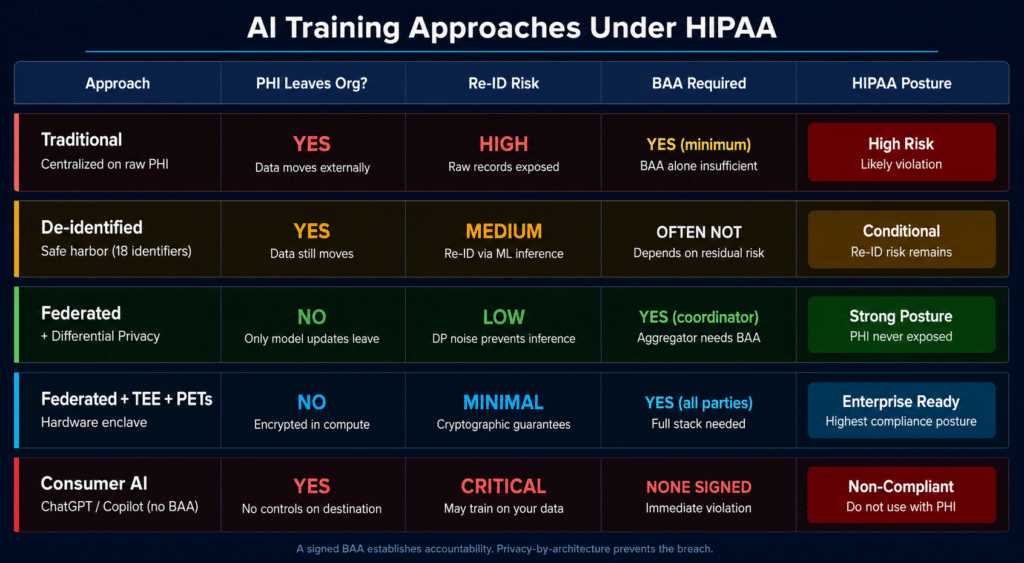
The approaches that enable genuine HIPAA compliant AI training share a common design principle: computation moves to the data rather than data moving to the computation. Instead of centralizing patient records in a training environment, the model training process runs inside or alongside the systems where PHI already lives, governed by the same controls that apply to any other PHI access.
Federated Learning
Federated learning in healthcare trains a shared model across multiple institutions without any patient data leaving its source system. Each participating hospital trains a local model on its own data and shares only the resulting model updates, not the underlying records. A central coordinator aggregates those updates into an improved global model, which is then distributed back to participants. NHS England’s federated analytics program, which spans data from 56 NHS trusts, demonstrated that federated approaches could identify clinical patterns across the national patient population without any trust sharing its records. Similar architectures have been deployed by Mayo Clinic and academic research consortiums including the TriNetX federated network, which connects over 160 health systems for real-world evidence research.
For enterprise-scale HIPAA compliant AI, federated learning solves two problems simultaneously. It keeps PHI within the covered entity’s own infrastructure, eliminating the data movement that creates the highest HIPAA exposure. And it enables training on genuinely diverse patient populations across multiple institutions ” the kind of breadth that produces models robust enough to deploy clinically without the data-sharing agreements that were previously required.
Trusted Execution Environments
Trusted execution environments provide hardware-enforced isolation for AI workloads that must process PHI in a shared cloud environment. The TEE creates a cryptographically verifiable enclave that even the cloud provider’s infrastructure cannot inspect. For healthcare organizations that need to leverage cloud computing capacity for large model training without exposing PHI to the cloud provider, TEEs offer a HIPAA-compatible path.
Privacy-Enhancing Technologies at Scale
Privacy-enhancing technologies including differential privacy, secure multi-party computation, and fully homomorphic encryption extend these protections further. Differential privacy adds mathematically calibrated noise to model updates so that no individual patient’s data can be inferred from the model. Secure multi-party computation and FHE allow model training on encrypted data, so PHI remains protected even during active computation.
In practice, enterprise HIPAA compliant AI deployments typically combine these approaches. Federated learning handles the distribution problem. Differential privacy protects against model inversion attacks. TEEs provide hardware assurance for sensitive compute nodes. The resulting architecture is more complex than a centralized training pipeline, but it is also more resilient: a breach of any single component does not compromise patient data because the patient data was never there.
What Does Enterprise-Scale HIPAA Compliant AI Actually Require?
The technical architecture is necessary but not sufficient. Large health systems that have deployed HIPAA compliant AI at scale consistently identify governance infrastructure as the harder problem: who has authority to approve a new training dataset, how are model access decisions audited, what happens when a participating institution withdraws consent for its data to continue contributing to a federated model.
The governance questions become more acute when AI crosses institutional boundaries. A health system that trains a federated model across its own facilities has relatively straightforward governance: one covered entity, one set of policies, one legal team. A research consortium spanning five academic medical centers in three states has five IRBs, five legal teams, five sets of patient consent frameworks, and potentially five different interpretations of what their data can be used for. The privacy-preserving architecture enables the collaboration; the governance infrastructure determines whether it actually happens.
Why This Matters:
The organizations that will win in healthcare AI are not necessarily those with the best models. They are those that build the trust infrastructure ” technical and organizational ” that lets them access the patient populations their competitors cannot reach because the compliance bar is too high.
For healthcare executives evaluating AI infrastructure, it’s worth distinguishing between solutions that secure data storage and those that secure computation. AWS HealthLake and Google Cloud Healthcare API are HIPAA-eligible services that protect data in transit and at rest ” but they require plaintext access to PHI during model training and inference. Cryptographic approaches like those built on fully homomorphic encryption and secure multi-party computation go further: PHI remains mathematically encrypted even while the model trains on it, so the computing party never has access to the underlying records. For health systems operating at institutional scale or across organizational boundaries, that architectural difference determines what collaborations are legally and operationally possible. The question is not just whether a vendor’s product is HIPAA compliant ” it is whether the vendor’s architecture supports healthcare AI collaboration across institutional boundaries, with the audit trail and governance controls that a regulatory examination or breach investigation will require.
What Does the EU AI Act Add for US Health Systems With European Operations?
US healthcare organizations with EU operations face an additional compliance layer that HIPAA alone does not address. The EU AI Act, which entered into force in August 2024 and begins phased enforcement in 2025, classifies most clinical AI systems as high-risk AI applications under Annex III, triggering obligations that go beyond what HIPAA requires.
Article 10 of the EU AI Act imposes data governance requirements specifically for high-risk AI training data: datasets must be relevant, representative, and free of errors. The organization must document data sources, data collection procedures, and the measures taken to detect and address bias. For health systems using federated learning across European hospital networks, Article 10 creates documentation obligations at the training data layer that are separate from and additional to the BAA and risk analysis requirements under HIPAA.
The EU AI Act also requires high-risk AI systems to maintain a technical file that includes the design specifications, the risk management system, and the post-market monitoring plan. US health systems that have built their AI compliance programs entirely around HIPAA and FDA SaMD frameworks will need to add a new documentation layer for any AI system that touches EU patient data or is deployed in EU clinical settings. Organizations building their AI infrastructure now should design governance systems that can satisfy both regulatory frameworks simultaneously, rather than retrofitting EU compliance onto a HIPAA-only architecture.
Why Is the Regulatory Bar for HIPAA Compliant AI Getting Higher?
The HHS Office for Civil Rights has signaled increased enforcement focus on AI and algorithmic systems. OCR’s HIPAA audit program now explicitly includes AI system data flows, training data access, and inference logging in its audit protocol review areas. Separately, the FDA has authorized more than 950 AI/ML-enabled medical devices as of 2023 and classifies most clinical AI systems as Software as a Medical Device (SaMD) subject to its AI/ML action plan, which includes requirements for transparency, real-world performance monitoring, and algorithm change protocols.
State-level health data privacy laws are creating additional obligations. Washington’s My Health MY Data Act, effective March 2024 for large organizations, imposes consumer health data protections that go beyond HIPAA and explicitly cover consumer health technologies and AI-derived health inferences. Nevada’s Consumer Health Data Law similarly extends health data protections to non-HIPAA-covered entities, which can include wellness apps and AI tools that infer health status from behavioral data.
Organizations that build HIPAA compliant AI on a foundation of genuine privacy architecture ” where PHI never centralizes, where audit trails are automated rather than manual, where the architecture enforces the policy rather than relying on people to follow it ” will find those investments pay dividends as the regulatory environment tightens. Organizations that built compliance on documentation and vendor contracts are running out of runway.