

Sensitive data discovery is the systematic process of scanning, identifying, and classifying data that requires special handling under regulatory law ” and it is the first step, not the last, in a protection workflow. The 2023 HHS Office for Civil Rights breach portal recorded 725 healthcare data breaches affecting more than 133 million individuals. In nearly every investigation that follows a breach of this scale, regulators ask the same question first: did the organization know what sensitive data it held and where? The answer is almost always incomplete.
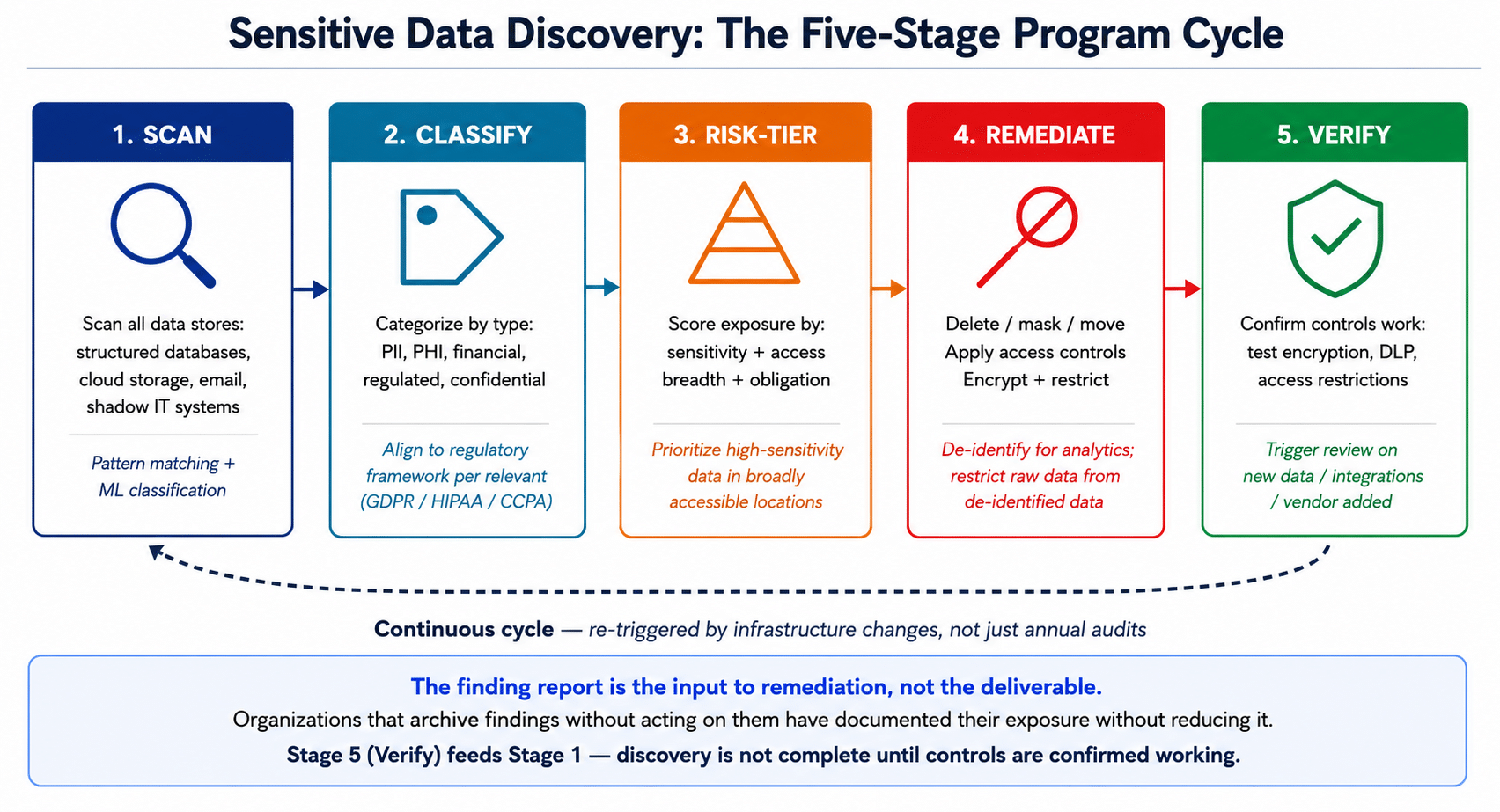
Not because organizations fail to run sensitive data discovery programs ” but because they treat discovery as a compliance checkbox rather than the beginning of a protection workflow. What regulated industries actually need is a complete cycle: discover, classify, assess risk, apply controls, and verify. The organizations that get breached are rarely those who never ran a discovery scan. They are those who ran the scan, generated a spreadsheet of findings, and then did not systematically act on what they found.
TL;DR
- Sensitive data discovery scans data environments to locate personal, regulated, or high-risk data that requires special handling.
- GDPR, HIPAA, CCPA, and equivalent frameworks all require organizations to know what sensitive data they hold ” and demonstrate appropriate controls over it.
- Personal data discovery covers not just structured databases but emails, documents, cloud storage, data warehouses, and shadow IT systems where sensitive data accumulates without formal governance.
- Discovery is the first step, not the destination. What happens after ” classification, risk assessment, remediation, and ongoing monitoring ” determines whether discovery actually reduces risk.
- Privacy-enhancing technologies extend discovery’s value by enabling organizations to analyze and use sensitive data without the exposure that comes from centralizing or moving it.
What Is Sensitive Data Discovery and Why Is It Hard?
The scope of what counts as sensitive data varies by regulatory framework, but in practice it covers a consistent core: personal information that can identify an individual, financial data subject to PCI DSS, health information covered by HIPAA or equivalent legislation, and data subject to national security or export control restrictions.
What makes sensitive data discovery genuinely hard is the distribution problem. Sensitive data does not live only in the production database your security team has mapped. It accumulates in email attachments, SharePoint folders, Slack exports, analytics data warehouses, machine learning training sets, test environments built from production copies, and third-party SaaS applications that employees adopted without IT involvement. A 2022 IBM Cost of a Data Breach Report found that shadow data ” data stored in locations outside formal governance ” was involved in 93% of cloud data breaches it analyzed. Sensitive data scanning that covers only formal systems misses most of the actual exposure.
The Discovery Problem:
Most organizations know where their sensitive data is supposed to be. The breach risk comes from where it actually is. Shadow IT, test database copies, email attachments, and unsanctioned SaaS tools hold sensitive data that no inventory accounts for.
What Do GDPR and HIPAA Require for Sensitive Data Discovery?
GDPR Article 30 requires controllers and processors to maintain a Record of Processing Activities (RoPA) documenting the categories of personal data processed, the purposes of processing, and the retention periods. This is not a legal nicety ” it is the document regulators ask for first in an investigation. A RoPA that does not reflect where personal data actually lives is a liability, not a compliance asset. Data compliance under GDPR requires that discovery be ongoing, not a one-time exercise, because personal data flows change every time a new tool is adopted, a new product is launched, or a new third-party integration is configured.
HIPAA’s Security Rule requires covered entities and business associates to conduct a risk analysis that identifies “where e-PHI is created, received, maintained, or transmitted.” The Office for Civil Rights has consistently cited inadequate risk analysis as a root cause finding in its enforcement actions. An inadequate risk analysis often traces back to an incomplete discovery process: if the organization does not know where its PHI lives, it cannot assess the risk to it, and it cannot demonstrate to an auditor that appropriate controls are in place.
CCPA and CPRA require businesses to respond to consumer requests to know what personal information has been collected and to delete it on request. Neither obligation can be fulfilled if the organization does not have a complete and current inventory of where personal information is stored. A deletion request that is honored in the production database but not in the analytics warehouse, the email archive, or the training dataset is a partial response ” and partial responses create ongoing regulatory and litigation exposure.
How Does the Sensitive Data Discovery and Classification Process Work?
Enterprise sensitive data discovery programs typically combine three scanning and classification approaches:
Pattern Matching and Regular Expressions
The most common starting point. Discovery tools scan data stores for patterns that match known sensitive data formats: Social Security Numbers (XXX-XX-XXXX), credit card numbers (PAN formats), email addresses, phone numbers, passport numbers, and similar structured identifiers. Pattern matching is fast and covers high-confidence sensitive data categories, but it produces false positives ” random strings that match SSN patterns but are not SSNs ” and it misses contextually sensitive data that does not match a standard pattern.
Machine Learning Classification
ML-based classifiers are trained to recognize sensitive content in context, not just by pattern. A model trained on examples of health-related free text can identify medical discussions in email threads that contain no structured PHI identifiers. ML classification extends discovery beyond structured data into unstructured content: documents, emails, chat logs, and free-text fields in databases. The tradeoff is that ML classifiers require training data, produce confidence scores rather than binary results, and need ongoing recalibration as data environments evolve.
Data Fingerprinting and Lineage Tracking
For organizations with known sensitive datasets, fingerprinting creates a reference signature that can be detected if the data is copied or moved. If a production database containing customer PII is copied into a test environment, fingerprinting can detect that the test environment now contains PII derivatives even if the records have been partially modified. Lineage tracking extends this by mapping data flows: understanding not just where sensitive data currently exists but where it originated and where copies may have propagated.
Classification Is Not a One-Time Exercise:
Most organizations run their first sensitive data discovery program and generate a point-in-time inventory. Six months later, that inventory is partly stale. New tools added. New data flows created. New vendors onboarded. Effective programs treat discovery as a continuous process with automated re-scanning triggered by infrastructure changes, not just annual audits.
What Should Regulated Industries Do After Sensitive Data Discovery?
This is where most sensitive data programs break down. The discovery phase produces a findings report. That report goes to a compliance officer or a security team. Without a defined remediation workflow, it generates discussion but not action. The data remains where it was found, with the same access controls it had before. The organization now has documented evidence that sensitive data exists in high-risk locations ” which is worse than not knowing, from a regulatory liability perspective, if the documented risk is not subsequently addressed.
Regulated industries that manage this well treat the discovery output as the input to a remediation pipeline with defined steps:
Step 1: Risk-Tier the Findings
Not all sensitive data exposures carry equal risk. A spreadsheet containing customer emails sitting in a shared internal drive has different risk than a database containing unencrypted Social Security Numbers accessible to any employee with a VPN. Risk tiering prioritizes remediation effort by combining data sensitivity (what type of data), exposure surface (who can access it), and regulatory obligation (which framework governs it). High-sensitivity data in broadly accessible locations with active regulatory obligations get addressed first.
Step 2: Apply Minimum Necessary Access
For sensitive data that must remain where it was discovered, the immediate control is access restriction. Most organizations find that sensitive data has been granted broader access than its use case requires. Applying minimum necessary access ” a HIPAA principle that applies equally to any sensitive data context ” means stripping permissions down to only those with a documented operational need and logging all subsequent access.
Step 3: Decide on Disposition
Discovery findings require a disposition decision for each category: keep, move, mask, or delete. Data that has no current business use and is past its retention period should be deleted. Data that is needed for analytics but not in its raw personal form should be de-identified or masked. Data that needs to remain in its current form should have controls applied and a documented retention policy.
The most important disposition question is whether sensitive data needs to move at all. Data de-identification can allow analytics, reporting, and machine learning use cases to proceed on a transformed version of the data that carries significantly reduced regulatory risk. Test and development environments that were built from production copies should be rebuilt from de-identified data or replaced with synthetic data that does not carry real sensitive records.
Step 4: Apply Technical Controls to What Remains
For sensitive data that must be retained in identifiable form, technical controls need to be applied and verified: encryption at rest and in transit, access controls with documented justification, data loss prevention policies that prevent exfiltration, and audit logging that captures every access to sensitive records. These controls need to be verified, not assumed. DLP policies that appear configured may have exceptions that render them ineffective. Encryption may be configured at the storage layer but bypass the application layer. Post-discovery remediation requires verification, not just policy deployment.
The Gap Most Programs Miss:
Discovery tells you where sensitive data is. It does not tell you whether the controls protecting it are actually working. A separate control verification step ” testing encryption, access controls, and DLP against the discovered inventory ” is what turns discovery findings into reduced risk.
How Do Privacy-Enhancing Technologies Protect Sensitive Data After Discovery?
Privacy-enhancing technologies address a core tension that discovery programs surface: sensitive data that must be retained for legitimate business purposes but creates ongoing exposure in its current form. The most common post-discovery challenge is not data that should be deleted ” it is data that must be kept but poses regulatory risk every time it is accessed, analyzed, or shared across team or organizational boundaries.
Federated learning enables AI model training on sensitive data without the data leaving the environment where it was discovered and classified. Instead of centralizing sensitive records for model training, federated approaches train model updates locally and aggregate only the mathematical gradients. The sensitive data never moves, which means the exposure created by centralization never occurs.
Secure multi-party computation enables organizations to run analytics and computations across sensitive datasets held by different teams or entities without any party seeing the underlying records of the other. A hospital network that has discovered sensitive patient data across multiple facilities can run population health analytics across the combined dataset without any facility ever transmitting its patient records outside its control.
Differential privacy adds calibrated mathematical noise to query results and model outputs, preventing the reconstruction of individual records from aggregate statistics. For organizations that have discovered sensitive data in analytics systems, differential privacy allows those systems to continue serving their analytical purpose while preventing the privacy leakage that aggregate queries can otherwise enable.
Why Does Sensitive Data Discovery Need to Be a Continuous Program?
The organizations that manage sensitive data risk most effectively have stopped treating discovery as an annual project and started treating it as a continuous monitoring capability. The trigger for a new scan is not the calendar. It is a change event: a new data source onboarded, a new SaaS tool approved, a new vendor relationship established, a new product feature that collects user input. Each of these events potentially introduces sensitive data into locations that the last discovery scan did not cover.
Continuous discovery programs integrate with cloud infrastructure monitoring to detect new data stores as they are created. They feed discovery findings into data catalogs and governance platforms that maintain a living inventory rather than a static spreadsheet. They alert on policy violations in near-real-time rather than surfacing them in quarterly reports. And they close the loop on remediation: tracking each finding through risk tiering, disposition decision, control application, and verification, rather than treating the findings report as the deliverable.
The regulatory pressure to maintain a current and accurate sensitive data inventory is only increasing. GDPR’s right to erasure, CCPA’s deletion rights, and HIPAA’s minimum necessary standard all assume that the organization has accurate, current knowledge of what it holds. Programs built on annual discovery scans and spreadsheet inventories are structurally unable to satisfy those obligations consistently. The move toward continuous personal data discovery is not a technology investment choice ” it is a compliance architecture requirement for organizations that operate at any meaningful scale.