

Data governance vs data architecture is one of the most misunderstood distinctions in enterprise data strategy. Most organizations have built one without the other. They invest in data architecture (storing, moving, and processing data efficiently) while governance remains a spreadsheet and a compliance checkbox. Or they enforce rigid governance rules that make their architecture painful to operate.
The distinction is direct: data governance sets the rules for what can be done with data. Data architecture builds the systems that enforce those rules at the operational level. Getting both right is what separates organizations that actually use their data from those that just store it.
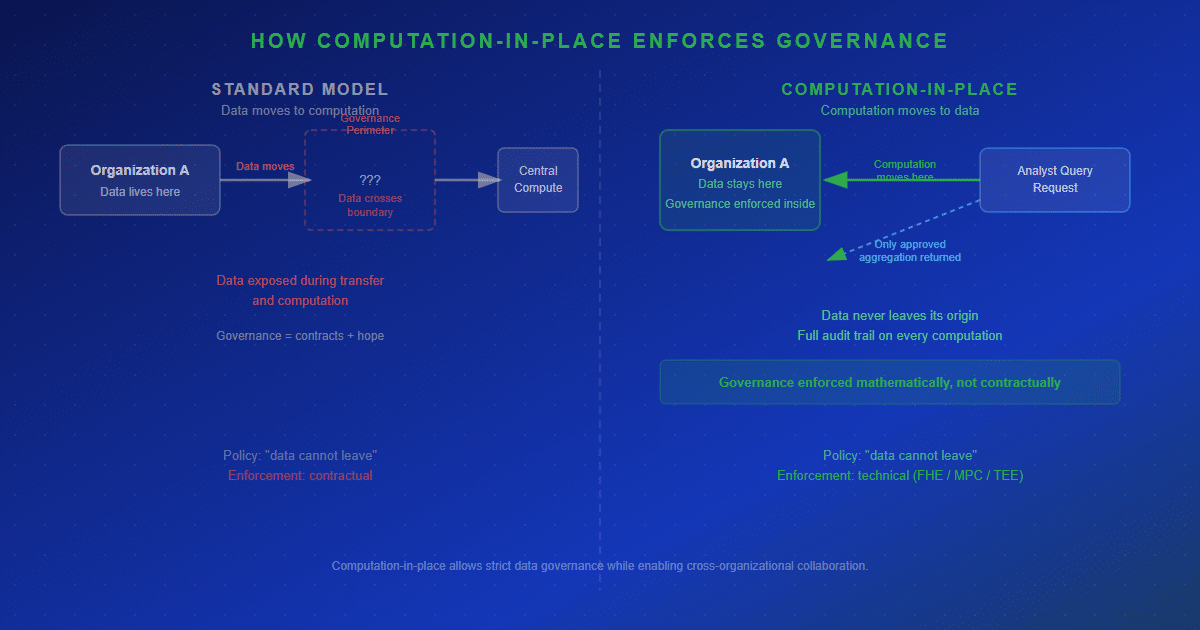
Alt text: Diagram illustrating the difference between data governance and data architecture as policy versus technical enforcement layers.
TL;DR
- Data governance = policies, access controls, and accountability. Data architecture = systems, infrastructure, and enforcement mechanisms.
- Governance without architecture is unenforceable. Architecture without governance is directionless.
- Both must develop together; governance defines what to enforce, architecture defines how.
- The hardest governance problems live in legacy systems never designed for policy enforcement.
- The data governance architect role exists specifically to bridge policy requirements and technical design.
What Is Data Governance?
Data governance is the framework of policies, processes, and controls that define who can access what data, for what purpose, under what conditions, and with what audit trail. It is the “who decides” layer.
Governance answers questions like: Can this analyst access customer transaction data? Is this use case compliant with GDPR? Who owns this dataset? What happens if data is used outside its intended scope?
Governance operates at the policy level. It does not determine how data is stored or moved. It defines authorization, compliance, lineage, and accountability. It is enforced through documentation, access controls, audit logs, and data stewardship roles.
Common governance frameworks include DAMA-DMBOK (the Data Management Body of Knowledge, a comprehensive management structure), DCAM (the Data Management Capability Assessment Model, widely used in financial services), and NIST’s data governance guidelines for regulated industries. Most enterprises layer regulatory requirements (GDPR, HIPAA, CCPA) onto a foundation of data ownership assignment, classification, and access policy. For a full breakdown of compliance requirements, see data compliance.
What Is Data Architecture?
Data architecture is the technical design that determines how data flows through an organization. It answers questions like: Where does data live? How does it move between systems? What format is it in? How is it encrypted? What happens if a system fails?
Architecture encompasses databases, pipelines, storage, processing frameworks, and integrations. It is enforced through code, infrastructure, and system design.
A well-designed architecture makes compliance easier by building controls into the system itself. A poorly designed architecture makes governance impossible to operationalize, no matter how clear the policies are on paper.
Key Differences: Data Governance vs Data Architecture
| Aspect | Data Governance | Data Architecture |
| Focus | Rules, policies, oversight | Systems, infrastructure, design |
| Primary concern | Compliance, risk, accountability | Performance, scalability, reliability |
| Enforced by | Policies, processes, audit trails | Code, infrastructure, system design |
| Ownership | Chief Data Officer, compliance, legal | Data engineers, architects, IT operations |
| Failure mode | Data misuse, breach, non-compliance | System downtime, data loss, bottlenecks |
| Time horizon | Strategic (months to years) | Operational (days to months) |
When governance fails without architecture: Policies exist on paper. An analyst who should see only aggregated data can access row-level records because the database does not restrict it. Compliance becomes manual review and hope.
When architecture fails without governance: The system is fast and scalable, but no one knows who owns what data, lineage is missing, and there is no audit trail when sensitive data is accessed.
Key Takeaway:
Architecture can make governance easier, but it is not a substitute for governance. A fully encrypted system with fine-grained access controls can still have no accountability for whether the analysis being run complies with the data’s intended use. Governance is about intent and accountability. Architecture is about technical enforcement.
How Data Governance and Data Architecture Work Together
The two intersect at the enforcement layer. Architecture provides the mechanisms (encryption, access control, logging, data segmentation). Governance defines the rules those mechanisms must enforce.
The operational integration follows three steps:
- Governance defines the rule: “Only approved researchers can access trial participant data, and access must be logged.”
- Architecture implements the mechanism: authentication (who you are), authorization (what you are allowed to do), and audit logging (every action recorded with timestamp, actor, and action).
- Operations enforces the policy: access requests go through a documented workflow, approvals are tracked, logs are monitored, and violations trigger alerts.
Most organizations have the first two and break down at the third. They have good governance documents and solid architecture, but the operational connection between them is missing. That gap is where uncontrolled data use happens.
Legacy Systems: Where Governance Frameworks Break Down
Most governance frameworks assume you are building from scratch. Most enterprises are not.
A bank has mainframes running since 1995. A hospital has an EHR locked into clinical workflows. A manufacturer has a monolithic ERP where separating data concerns is architecturally impossible. These systems have no native audit capability, no fine-grained access control, and no practical path to redesign without massive cost and operational risk.
The standard response is wrapping: add governance at the API or gateway layer. The legacy system stores data without logging; you log at the gateway. This buys time, but has structural limits:
- Bypass risk: If someone connects directly to the database, logging stops entirely.
- Outage gaps: If the legacy system crashes, continuous compliance cannot be proven.
- Invisible internal movement: Data copying between tables inside the system is invisible to the governance layer.
- Latency cost: Adding authentication and logging at the gateway adds 15-40ms per query on average, which compounds at scale.
The alternative is rebuilding with governance built in. This works, but costs millions of dollars and two to three years of work, with operational risk during migration. Most enterprises use a hybrid: phase out legacy systems over time, rebuild for the most sensitive data, wrap and accept documented audit gaps for secondary systems.
Architecture Note:
Most enterprises spend 60-70% of governance effort on legacy system integration, not on new system design. Governance frameworks that assume greenfield conditions consistently underestimate this and produce compliance plans that fail operationally.
The Performance-Cost Tradeoff in Data Governance
Every governance mechanism has a cost. Organizations that don’t quantify these costs end up either under-governed (unauditable) or over-governed (unusable).
| Mechanism | Typical Cost | Practical Constraint |
| Role-based access control | 15-40ms added per query | Acceptable for interactive use; problematic above 5,000 queries/sec |
| Comprehensive audit logging | 100-500 GB/day per major database | Most orgs log logins and exports, not individual reads |
| Encryption in transit/at rest | ~5% latency overhead | Standard on modern hardware; negligible |
| Encryption in use (FHE/TEE) | 10x to 10,000x overhead | Enforces governance without data exposure; computationally intensive |
The result in practice: most organizations log roughly 20% of real data access. A breach involving read-only access without exporting data goes undetected. The deliberate path forward requires a clear risk assessment: identify the most sensitive data, govern it comprehensively even at higher cost, and accept that lower-sensitivity data may be governed loosely. For a deeper look at data categories, see sensitive data types.
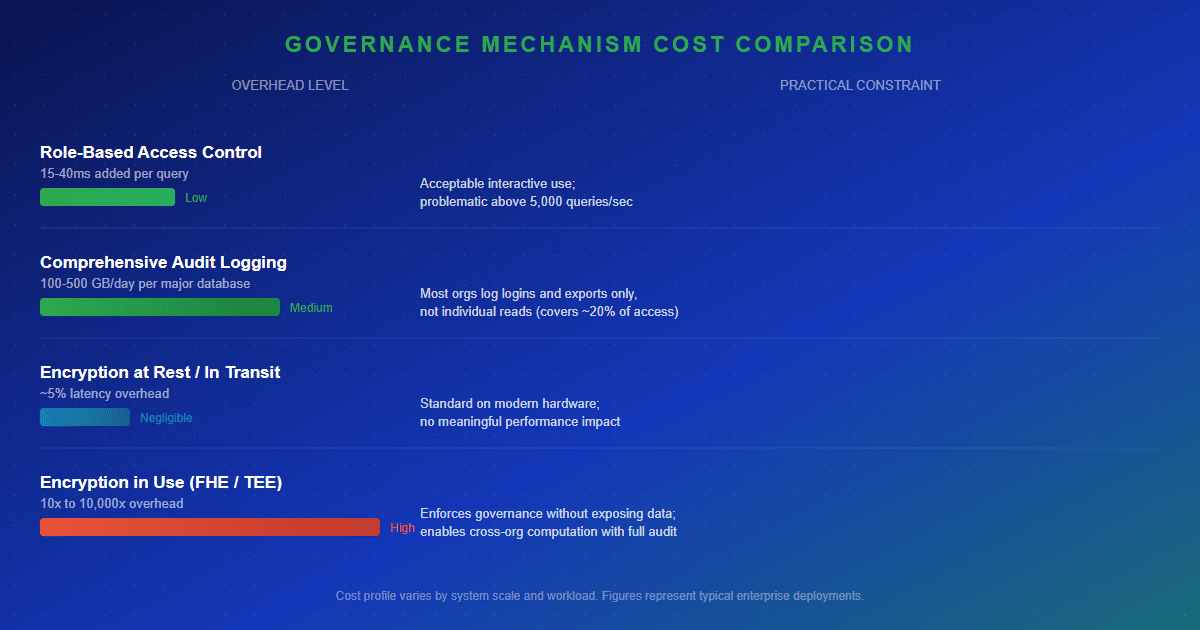
Alt text: Chart comparing the performance cost of data governance mechanisms from role-based access control to encryption in use.
What Comes First: Governance or Architecture?
Ideally, both develop together. But when you must prioritize, the answer depends on what is actually broken.
Start with governance if you have compliance violations, audit failures, or cannot prove data lineage. Define the policies first: what data must be protected, what compliance rules apply, who owns what. Then build architecture to enforce those requirements. Architecture built without governance context is routinely over-engineered for performance and under-designed for accountability.
Start with architecture improvements if your teams cannot access data they legitimately need. When analysts wait weeks for routine approvals or data engineers build one-off pipelines for every use case, governance is too restrictive or architecture is too rigid. Streamlining usually requires architectural changes before governance tightening.
The most common mistake: treating governance as a documentation exercise rather than an operational discipline. Written policies that no system enforces are not governance.
The Role of a Data Governance Architect
The data governance architect role has emerged specifically to bridge the gap between policy and technical enforcement. The role sits at the intersection of governance and architecture: translating policy requirements into technical specifications, designing architectures that make compliance the path of least resistance, and ensuring that new systems treat audit, lineage, and access control as first-class design requirements.
In practice, the data governance architect evaluates which legacy systems can be wrapped vs. rebuilt, maps governance requirements to specific technical controls, and maintains the gap analysis between what policies require and what current systems actually enforce. The role operates simultaneously across compliance, legal, and engineering, and is the person most responsible for ensuring that governance intent survives contact with production infrastructure.
How Duality Helps
Duality addresses a specific governance and architecture problem: how to share data across organizational boundaries while maintaining full governance control.
Most data architectures assume data moves to where computation happens. Most governance frameworks assume data stays in-house. When financial institutions need to match datasets without exposing positions, or health systems need to analyze patients across institutions, neither assumption holds. Standard governance frameworks break.
Duality’s architecture inverts the model: computation moves to where data lives. Data stays in place. Governance is enforced at the computation level, not just the access level. An analyst can run a query on a remote dataset, but only pre-approved aggregations are returned, every computation is logged, and data never leaves its originating system. These approaches are part of the broader landscape of privacy-enhancing technologies that organizations are adopting for cross-boundary collaboration.
This means governance policies can remain strict about data movement while enabling legitimate cross-organizational analysis. The rule “data cannot leave the system” becomes technically enforceable. For organizations navigating data sovereignty requirements, this model is increasingly relevant as regulations tighten around where data can be processed.